According to UNESCO-derived standards of education, one critical element in assessing a curriculum is the presentation of peace and conflict resolution as a value in education. The overall aim of these standards is to create a more tolerant environment for students worldwide, where they learn the values of peace, respect, tolerance, and democratic principles. Conflict resolution is a value that fully embodies the broader principles of peace and tolerance promoted within the educational system, and thus provides an especially useful lens through which to assess sub-Saharan African curricula. Shaped by histories of colonialism and inter-ethnic conflict, Ethiopia, Nigeria, and South Sudan have each gone to considerable lengths to embed the values of peace and reconciliation in their educational frameworks. As a result, conflict resolution serves as a particularly meaningful perspective from which to evaluate how these curricula seek to cultivate tolerance and stability.
Across African curricula, the teaching of conflict resolution as a civic and moral value emerges as a recurring theme, particularly in Ethiopia, Nigeria, and South Sudan. In all three contexts, peace is presented as a practical skill set, integral to democratic participation, social stability, and national development. Textbooks consistently emphasize non-violent approaches such as dialogue, negotiation, reconciliation, and cooperation, while condemning violence as socially and economically destructive. Moreover, peace education is embedded across multiple disciplines, demonstrating a systematic curricular effort to cultivate peaceful coexistence as a shared societal value. This broad consensus suggests that, despite differing national trajectories and histories, these countries view conflict resolution as essential for nurturing responsible citizens and ensuring long-term stability.
Ethiopia:
Ethiopia is one of the world’s oldest Christian nations, with the religion enforced by the monarchy until the twentieth century. Ethiopia is home to over 80 ethnic groups, the largest being Oromo and Amhara, followed by Tigray, Somali, and Sidama. While this diversity is reflected in the country’s ethnic federal system, it has also fueled tensions. The country has a large Muslim presence, comprising roughly one third of the population, and has a long history of coexistence between the two religions, with some tension under more dogmatic national leaders. Ethiopia, one of the only African nations never colonized, was briefly occupied by Italy from 1936 to 1941 before Emperor Haile Selassie was restored. His modernization efforts and international leadership ended with his overthrow in 1974 by the Marxist Derg regime, whose rule brought repression, famine, and civil conflict until its fall in 1991. Due to its successful resistance and brief experience of occupation, Ethiopia became a symbol of independence and anti-colonial pride across Africa, later hosting the Organization of African Unity in Addis Ababa. Today, Ethiopia remains a major regional power but faces deep political and ethnic challenges.
Based on its history as an independent nation, fighting off bids for colonization, Ethiopian school textbooks consistently present conflict resolution as a central civic and democratic value, framing it as indispensable to both social stability and national cohesion. This is not simply discussed as a practical tool, but as a normative principle that students are encouraged to internalize. The Grade 11 History textbook, for example, draws on episodes of past conflict between Ethiopians, Christians, and Muslims to highlight the importance of resolving disputes peacefully, suggesting that such historical models provide lessons for contemporary society. Similarly, the Grade 12 Geography textbook situates conflict resolution within Ethiopia’s own cultural context, showcasing indigenous mechanisms that reduce inter-ethnic tensions through processes of reconciliation, forgiveness, and respect for elders. These examples emphasize that peaceful resolution is not only desirable, but deeply rooted in Ethiopian traditions, reinforcing its legitimacy as a civic value.
At the same time, the textbooks acknowledge the complexities of real-world conflict. The Grade 10 Citizenship textbook, for example, concedes that aggression may be necessary in the face of foreign invasion, before ultimately emphasizing the importance of peace. This nuance reflects the lasting imprint of Ethiopia’s historical encounters with colonial and external threats, demonstrating that while non-violence and reconciliation are taught as guiding principles, they are framed against a backdrop of national vulnerability. Overall, the curriculum deliberately cultivates conflict resolution as a moral and social value, embedding it within both Ethiopia’s historical memory and its indigenous traditions, and promoting it as a cornerstone of democratic citizenship.
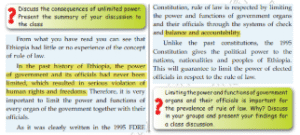
Image: Citizenship, Grade 10, pp. 42, 98-99
Nigeria:
Before colonial rule, the territory of present-day Nigeria was home to diverse kingdoms and societies. In the late 19th century, Britain consolidated control of the country through conquest and treaties, formally creating the Colony and Protectorate of Nigeria in 1914 by merging the northern and southern protectorates. This colonial unification bound together regions with very different histories, religions, and cultures, through indirect governance; they relied on Muslim emirs in the North and opened the South to Christian missionaries, introducing western education. As a result of this rule, the North became predominantly Muslim, while Christianity thrived in the South. Nigeria is also home to over 250 ethnic groups, the most dominant of which are the Hausa-Fulani, Yoruba and Igbo, all of which have distinct ethnic identities tied to their respective places of dwelling. These regional divides and colonial legacy were inherited by Nigeria upon its independence in 1960, creating regional tensions evident today.
Given this legacy of colonialism, there is a strong emphasis on independence and anti-colonial narratives in Nigeria, combined with a desire to retain peace and stability. In a manner similar to Ethiopia, emphasis on conflict resolution as a civic value is evident in the Nigerian curriculum, where textbooks across multiple subjects consistently highlight peace, dialogue, and non-violence as essential foundations for democratic citizenship and national cohesion.
Nigerian textbooks place a strong normative emphasis on peace and non-violent conflict resolution, presenting these not only as desirable societal outcomes but also as practical skills for democratic citizenship. Christian Religious Studies textbooks articulate this principle explicitly, stating that “war is not good for any nation,” while History materials commemorate significant peace-building moments in Nigeria’s past. Across subjects, students are encouraged to acquire practical competencies, such as conflict resolution, cross-cultural communication, and cooperation, defined in one History text as “agreement … among a group or groups of people.”
The curriculum links these values directly to the attainment of peace, with multiple subjects guiding students to define and analyze concepts such as conflict, cooperation, and disagreement, while stressing the role of dialogue and communication in addressing disputes. Civic Education textbooks outline specific skills, such as dialogue, negotiation, and arbitration, as mechanisms for restoring peace, whereas New Government textbooks position problem-solving and peace as central learning objectives. Civic and Security Education textbooks extend this framework to contemporary issues, citing the Amnesty Project in the Niger Delta as a case study in peaceful conflict resolution mediated through multinational organizations. Similarly, History textbooks highlight Nigeria’s contributions to continental unity and peaceful diplomacy, referencing reconciliation initiatives in post-war contexts as models to be emulated.
Moreover, the curriculum seeks to normalize conflict as part of social life while steering students toward constructive responses. For instance, a Basic Social Studies textbook identifies dissatisfaction with government as a potential source of conflict but stresses the positive outcomes of non-violent approaches, such as the generation of new ideas and leadership reform. This mirrors the Ethiopian curriculum, which acknowledges the potential positive aspects of conflict, while ultimately returning to a strong emphasis on conflict resolution as the desired approach. By presenting conflict as both a challenge and an opportunity, these materials cultivate a mindset in which peace and reconciliation are practical values to be enacted in civic and political life.
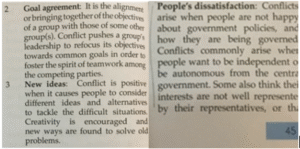
Image: Basic Social Studies with Security Education, Grade 9, (2015) pp. 45-46.
South Sudan:
Sudan became independent in 1956, following years under British-Egyptian colonial rule. Similar to Nigeria, the country was Christian in the South, and predominantly Muslim in the North; both were administrated separately. The separation of these two areas has contributed to regional tensions post-independence, with two civil wars occurring in which Southern rebels fought against the Khartoum government’s efforts to impose Islamic law. The end of these wars occurred in the 2005 Comprehensive Peace Agreement, leading to a referendum, whereby the South voted overwhelmingly for independence, establishing South Sudan as a state in 2011. Despite this, devastating civil wars have continued, with fragile peace agreements plastering over entrenched societal issues; South Sudan continues to face challenges in maintaining stability in the new nation. It is also home to a multiplicity of ethnicities, with more than 60 groups, the largest of which are the Dinka and Nuer, which have endured cycles of hostility between them.
Considering the nascence of this state, and its history fraught not only with colonialism but also significant levels of infighting, the South Sudanese education system has put forth efforts to entrench peace education among the next generation. South Sudanese textbooks place a strong normative emphasis on peace as both a civic value and a foundation for national development. The Grade 8 Social Studies textbook explicitly links peace with societal progress, encouraging students to view reconciliation and the pursuit of harmony as pathways to improving their communities. Peace is thus framed not only as a moral good but as a practical necessity for building a stable and prosperous society.
The Grade 10 Citizenship textbook broadens this perspective by situating violence within a wider regional and continental context. Students are prompted to recognize the harmful socioeconomic consequences of conflict for many African countries, with South Sudan presented as a case in point. By underscoring the devastating effects of violence on development and stability, the text explicitly calls for non-violence as the appropriate means of resolving disputes, thereby embedding peace into both personal ethics and national policy discourse.
Peace education is further reinforced in Grade 8 Social Studies, which instructs students to integrate anti-violence into daily life. Texts promote dialogue over violence and emphasize peacekeeping mechanisms designed to foster unity and coexistence. Students are encouraged to recognize the necessity of living peacefully with others and the possibilities of achieving reconciliation through non-violent approaches. Together, these materials reveal a deliberate curricular effort to instill in students the conviction that peaceful coexistence is attainable, desirable, and indispensable for the nation’s recovery and development.
Image: Social Studies, Grade 8, p.86
While the shared emphasis on non-violence and reconciliation underscores a common pedagogical goal between these three countries, each curriculum reflects its unique historical and political context. Ethiopia situates peace within its indigenous traditions and historical memory, acknowledging the defensive use of violence against foreign aggression but ultimately privileging reconciliation. Nigeria integrates peace education into a broader framework of democratic participation and civic responsibility, even allowing for the recognition of conflict’s constructive potential when resolved peacefully. South Sudan, by contrast, frames peace as an existential necessity, directly tied to development and survival in a post-conflict society, with violence depicted as wholly destructive. Unlike the Nigerian and Ethiopian systems, the South Sudanese education system does not include caveats that leave space for violence; instead, it unequivocally condemns it, reflecting a deliberate effort to help heal society from the deep scars of recent conflict. Taken together, these cases highlight the ways in which African states deploy education as a means of embedding conflict resolution into civic identity, each tailoring the message to its own historical experience, yet collectively affirming peace and conflict resolution.